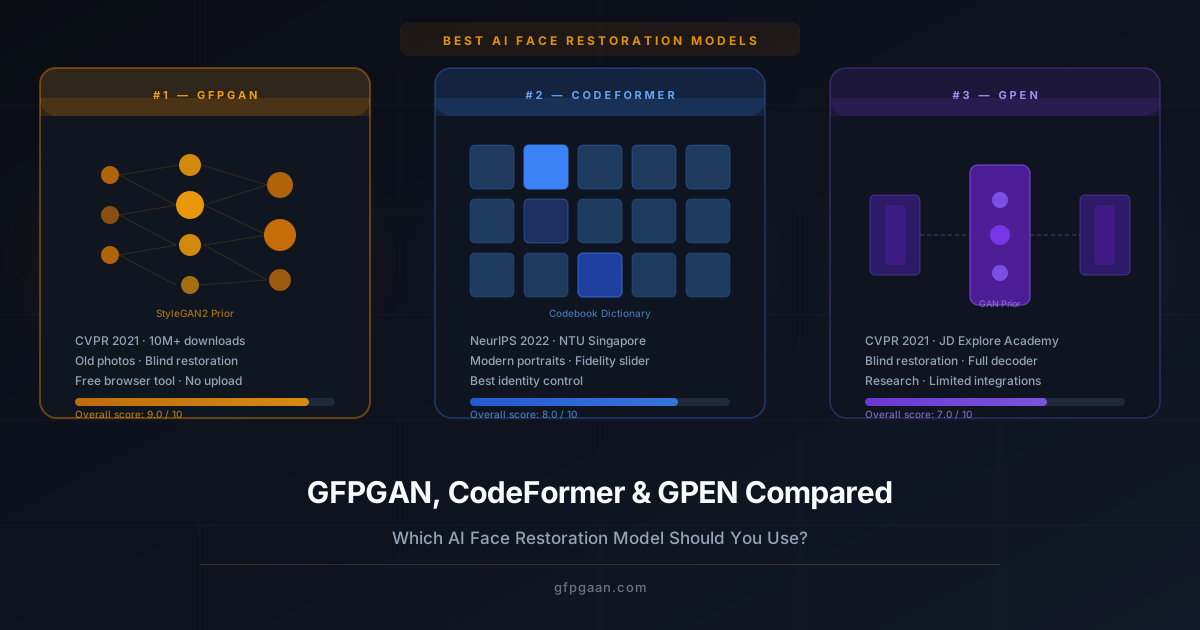
Best AI Face Restoration Models Compared: GFPGAN, CodeFormer, GPEN
GFPGAN, CodeFormer, and GPEN compared on identity preservation, speed, free access, and real-world restoration quality. Which model suits which photo.

Three AI models lead the field of face restoration: GFPGAN, CodeFormer, and GPEN. Each took a meaningfully different technical approach. Each has distinct strengths. And for different photo types and use cases, the right choice changes.
This guide compares all three — best AI face restoration models GFPGAN CodeFormer GPEN — across every dimension that matters: restoration quality, identity preservation, speed, free online access, and real-world usability. No hype — just a clear, technical breakdown.
What Is AI Face Restoration?
Before comparing models, it helps to understand what the problem actually is.
A degraded face image — blurry, compressed, grainy, or old — has lost information. Simple sharpening or upscaling cannot recover that information because it was never there to begin with. What those tools do is mathematically interpolate between existing pixels — which produces soft, smeared, or ringing output.
AI face restoration approaches this differently. Instead of working only with what is in the image, these models draw on prior knowledge of what human faces should look like — learned from millions of real face images during training. They use that knowledge to reconstruct the missing detail in a way that is both realistic and identity-faithful.
The three models below each solved this problem in a distinct way.
Model 1: GFPGAN
Full name: Generative Facial Prior Generative Adversarial Network
Published: CVPR 2021 (Tencent ARC)
License: MIT open source
Availability: Open-source weights on GitHub and Hugging Face
How It Works
GFPGAN uses a generative facial prior — a rich set of face knowledge extracted from a pre-trained StyleGAN2 model. This prior is injected directly into the restoration network via spatial feature transform layers. The result is a model that can reconstruct severely damaged faces by drawing on deep knowledge of face structure, even when the source photo contains almost no usable information.
The pipeline is:
- Detect and align faces
- Encode the degraded input
- Inject the generative prior to fill in missing detail
- Blend the restored face back into the original image
GFPGAN Strengths
- Excellent on heavily degraded and old photos
- Fast single-pass inference (sub-second on GPU)
- Native integration in Stable Diffusion WebUI
- Free browser-based tool — no upload, 100% private
- Consistent results across a wide range of degradation types
GFPGAN Limitations
- Less fine-grained fidelity control than CodeFormer
- Can occasionally over-smooth on mildly degraded modern portraits
- Face-specific — does not enhance backgrounds
Best for: Old photo restoration, severely degraded images, privacy-sensitive workflows, browser-based free restoration
Model 2: CodeFormer
Full name: CodeFormer — Robust Face Restoration via Code Dictionary Lookup
Published: NeurIPS 2022 (NTU Singapore)
License: MIT open source
How It Works
CodeFormer replaces the GAN prior with a codebook-based approach. During training, it builds a dictionary of high-quality face components. At inference, it looks up the degraded face in this codebook to find the closest matching clean components. A fidelity weight parameter (0 to 1) lets the user control the trade-off: at 0, CodeFormer prioritizes quality; at 1, it maximizes identity faithfulness to the original.
This controllability is CodeFormer’s defining feature — and it makes it the preferred choice when the person in the photo is recognizable and you need to preserve every specific feature.
CodeFormer Strengths
- Best identity preservation on mildly degraded modern portraits
- Fidelity weight slider gives precise control over reconstruction
- Sharp, detailed eye texture on portrait photos
- Strong benchmark performance (FFHQ-Test, CelebA-Test)
CodeFormer Limitations
- Slower inference than GFPGAN (codebook lookup adds overhead)
- Most online implementations require server upload (privacy concern)
- Can struggle on severely degraded photos where codebook has limited matches
- Requires local installation for offline/private use
Best for: Modern portrait restoration, fine-grained identity control, research workflows
Model 3: GPEN
Full name: GAN Prior Embedded Network for Blind Face Restoration
Published: CVPR 2021 (JD Explore Academy)
License: Open source
How It Works
GPEN is the third major model in the ai face restoration models GFPGAN CodeFormer comparison landscape. Like GFPGAN, it uses a GAN prior from a pre-trained StyleGAN2 model. However, GPEN embeds the GAN prior differently — it treats the entire StyleGAN2 generator as a decoder within a U-Net-like encoder-decoder restoration framework.
In practice, GPEN applies the generative prior at the full image level rather than through spatial feature transforms. This gives it different texture characteristics — sometimes producing slightly more uniform skin texture compared to GFPGAN’s more varied output.
GPEN Strengths
- Good performance on blind face restoration benchmarks
- Full-image GAN prior produces coherent output
- Works well in research pipelines
- Handles a range of degradation levels
GPEN Limitations
- Smaller community and fewer maintained integrations than GFPGAN or CodeFormer
- No widely available free browser-based implementation
- Less development activity since 2022
- Slightly behind GFPGAN and CodeFormer on modern benchmarks
Best for: Research comparisons, academic experiments, supplementary validation in blind face restoration studies
GFPGAN vs GPEN: How Do They Differ?
Both GFPGAN and GPEN use a StyleGAN2 prior — this is the core similarity that makes people compare them directly. The key difference is in how the prior is applied:
- GFPGAN injects the prior through spatial feature transform (SFT) layers within a dedicated restoration network. This produces more spatially controlled output — the prior helps different regions of the face independently.
- GPEN uses StyleGAN2 as a full decoder, treating restoration as a GAN generation problem with the degraded input as a condition. This can produce very natural-looking output but is less controllable at a region level.
In practice, gfpgan vs gpen comparisons on standard benchmarks show GFPGAN with slightly better identity preservation (higher FaceNet similarity) while GPEN sometimes produces marginally smoother overall texture.
Verdict: For real-world use, GFPGAN is the better choice due to its faster inference, larger community, and more maintained ecosystem. GPEN vs GFPGAN is mostly a research-level question at this point — GPEN has less active development and fewer production integrations.
Full Comparison: Best AI Face Restoration Models
| Criteria | GFPGAN | CodeFormer | GPEN |
|---|---|---|---|
| Published | CVPR 2021 | NeurIPS 2022 | CVPR 2021 |
| Core approach | GAN prior (SFT injection) | Codebook dictionary lookup | GAN prior (full decoder) |
| Old photo restoration | Excellent | Good | Good |
| Modern portrait restoration | Good | Excellent | Good |
| Blind face restoration | Excellent | Good | Good |
| Identity preservation | Very High | Very High (+ slider) | High |
| Processing speed | Fast | Medium | Medium |
| Fidelity control | No | Yes | No |
| Free online (no upload) | Yes | No | No |
| Browser-native tool | Yes | No | No |
| Stable Diffusion integration | Native | Plugin | No |
| Community & maintenance | Very Active | Active | Limited |
| Open source | Yes (MIT) | Yes (MIT) | Yes |
Which Model Wins on Blind Face Restoration?
Blind face restoration means restoring a face without knowing what specific degradation was applied — the model must handle any combination of blur, noise, compression, and low resolution simultaneously.
This is the hardest test — and GFPGAN was specifically designed for it. Its generative prior provides a strong enough constraint that it can fill in missing detail even when the degradation is unknown and severe. GPEN also targets blind restoration and performs well. CodeFormer performs better when the degradation is known and moderate.
Winner for blind face restoration: GFPGAN
Which Model Is Best for Identity Preservation?
For strict identity preservation on modern portraits with mild damage, CodeFormer at fidelity=1.0 is the most precise. Its codebook lookup finds the closest match to the actual face structure.
For identity preservation on severely degraded inputs where the source identity signal is weak, GFPGAN wins — it is architected specifically around identity retention, injecting identity signal from the degraded input through spatial feature transform layers instead of leaning on the generative prior alone.
Winner on mildly damaged modern portraits: CodeFormer
Winner on severely damaged or old photos: GFPGAN
Which Is the Best Free AI Face Restoration Online?
For free access without uploading your photos, GFPGAN wins outright — the weights are public, and it runs offline on your own machine once installed. It is also the model most widely wrapped by free hosted demos. (The enhancer on this page is a local Canvas-based filter, not GFPGAN itself — see our installation guide to run the real model.)
CodeFormer and GPEN are similarly gated behind hosted demos. Most “free online CodeFormer” tools route your photos through Hugging Face Spaces or third-party APIs, which means your image is uploaded to a server — worth checking before you send an identifiable family photo.
Winner for free online access: GFPGAN
Which Should You Use in 2026?
For the vast majority of users — restoring old family photos, fixing blurry portraits, recovering JPEG-compressed images, or processing photos privately — GFPGAN is the best choice. It is free, well documented, fast on a GPU, and produces excellent results across the full range of common photo types.
For professional workflows where you need fine-grained identity control on modern portraits and are comfortable installing software locally, CodeFormer is worth adding to your pipeline — ideally as a second pass after GFPGAN.
GPEN is primarily relevant for research comparisons and academic benchmarks. For production use, GFPGAN’s ecosystem advantage makes it the pragmatic choice.
Try the #1 Free AI Face Restoration Model
GFPGAN — Free, Private, Browser-Native
No upload. No account. No server. Your photo stays on your device.
Restore a Photo Free →Related Guides
- CodeFormer vs GFPGAN: Deep Comparison — Head-to-head between the two leading models.
- GFPGAN Face Restoration: Before & After Examples — Real results across different photo types.
- GFPGAN AI Face Restoration Guide — Complete introduction to GFPGAN.
- Face Restoration Guide — the broader concept explained, with links into every related guide.
- Best AI Face Restoration Tools & Apps — the tools and apps built on top of these models, compared.
Frequently Asked Questions
What are the best AI face restoration models in 2026?
The three leading models are GFPGAN, CodeFormer, and GPEN. GFPGAN is the best all-around model for free online use, old photo restoration, and privacy-sensitive workflows. CodeFormer leads on identity preservation for modern portraits. GPEN is strong for blind face restoration research.
Is GFPGAN better than CodeFormer?
For most users, yes. GFPGAN is faster, easier to install, and handles a wider range of degradation types. CodeFormer outperforms GFPGAN specifically on modern portraits with mild damage where fine identity detail must be preserved.
What is GPEN and how does it compare to GFPGAN?
GPEN (GAN Prior Embedded Network) also uses a StyleGAN2 prior for blind face restoration, similar to GFPGAN. The key architectural difference is that GPEN uses StyleGAN2 as a full decoder rather than injecting the prior through SFT layers. In practice, GFPGAN has better community support, faster inference, and more maintained integrations — making it the preferred choice for production use.
Which AI face restoration model is free online without uploading photos?
All three can be run locally, which is the only way to guarantee your photos are not uploaded anywhere. GFPGAN has the simplest local setup and the broadest tooling support. Free online versions of all three — including GFPGAN — are server-side, so your image does leave your device.
Can I use GFPGAN and CodeFormer together?
Yes. Some professional restoration pipelines run GFPGAN first for an initial blind face restoration pass, then apply CodeFormer at high fidelity for identity refinement. This two-pass approach combines GFPGAN’s reconstruction strength with CodeFormer’s identity precision.
Which model is best for restoring old black-and-white photos?
GFPGAN is the best choice for old black-and-white photo restoration. Its generative prior handles the severe degradation typical of scanned archival prints — grain, low dynamic range, fading, and scan artifacts — better than CodeFormer or GPEN on average.