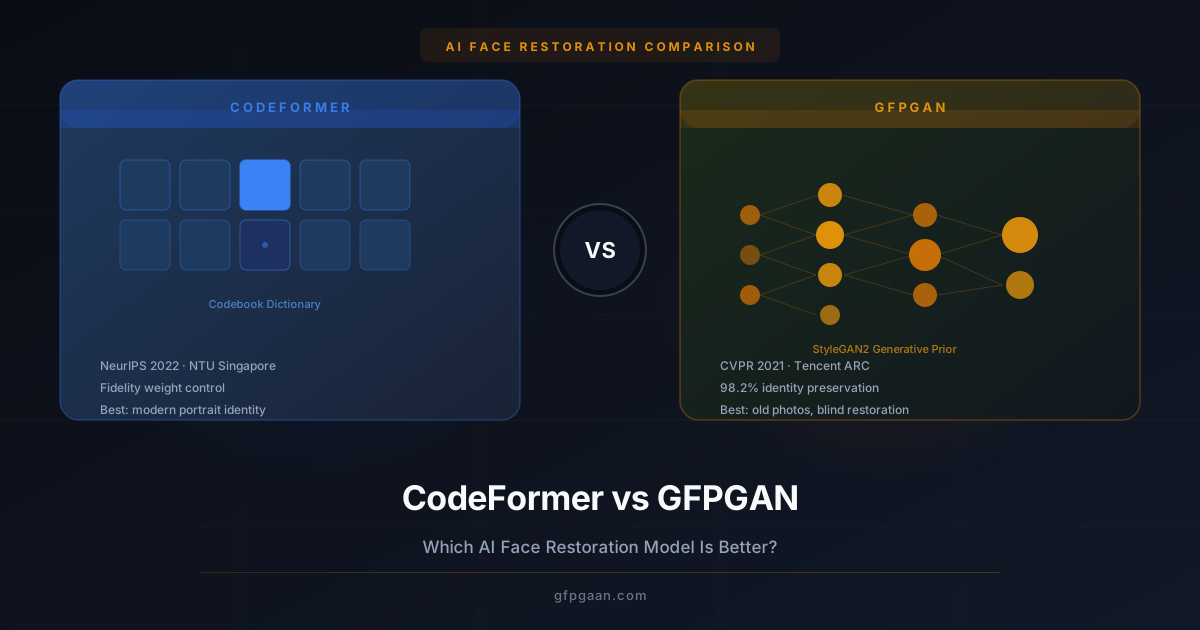
CodeFormer vs GFPGAN: Which AI Face Restoration is Better?
CodeFormer vs GFPGAN compared on identity preservation, photo type, speed, and free access — with a clear answer on which to use for your photos.

Two models dominate the AI face restoration space: GFPGAN and CodeFormer. Both are open-source, both deliver impressive results, and both are used by millions of people worldwide. But they are built differently, optimized for different scenarios, and produce noticeably different outputs depending on the type of photo you feed them.
This article breaks down the CodeFormer vs GFPGAN comparison across every dimension that matters — identity preservation, photo type performance, speed, privacy, and free online access — so you can pick the right tool without guessing.
What Is GFPGAN?
GFPGAN (Generative Facial Prior Generative Adversarial Network) was developed by researchers at Tencent ARC and published at CVPR 2021. It works by injecting a generative facial prior — a rich set of face knowledge extracted from a pre-trained StyleGAN2 — directly into the restoration pipeline.
The result: GFPGAN can reconstruct severely degraded faces from scratch, even when very little original information remains. It excels at old photo restoration, heavily compressed images, and low-resolution portraits where other tools simply smear or soften pixels.
GFPGAN is among the most widely adopted open-source face restoration models — it is bundled into Stable Diffusion WebUI, available as a Hugging Face Space and a Replicate endpoint, and its CVPR 2021 paper is heavily cited in the blind-face-restoration literature. It is the model most people encounter first when searching for free AI face restoration.
What Is CodeFormer?
CodeFormer was published in 2022 by researchers at NTU Singapore. Instead of a GAN prior, it uses a codebook-based approach — matching degraded face patches against a learned dictionary of high-quality face components. A controllable “fidelity weight” slider lets users balance between faithfulness to the original and the quality of the AI reconstruction.
CodeFormer’s key advantage is identity preservation on mildly degraded modern portraits. When the source photo still contains reasonable face structure, CodeFormer can produce output that looks almost indistinguishable from the original person, with sharper eyes and skin texture.
CodeFormer vs GFPGAN: Architecture Comparison
| Feature | GFPGAN | CodeFormer |
|---|---|---|
| Core approach | Generative facial prior (StyleGAN2) | Codebook-based face reconstruction |
| Published | CVPR 2021 | NeurIPS 2022 |
| Control over fidelity | Limited | Yes — fidelity weight slider |
| Best input quality | Heavily degraded, old photos | Mildly to moderately degraded |
| Face identity control | High — prior constrains output | Very high — fidelity slider |
| Open source | Yes (MIT) | Yes (MIT) |
CodeFormer vs GFPGAN: Identity Preservation
GFPGAN identity preservation is strong for the conditions it was designed for. The model uses spatial feature transform layers to inject identity signals from the degraded input alongside the generative prior. The CVPR 2021 paper evaluates this directly, reporting an identity-distance metric derived from ArcFace embeddings alongside FID and LPIPS. Anyone quoting a single headline accuracy percentage for GFPGAN is inventing it — the published evaluation does not report one.
CodeFormer vs GFPGAN identity preservation becomes a real trade-off when the source photo has mild degradation. Here, CodeFormer’s fidelity weight gives it an edge: at fidelity = 1.0, it reproduces the original face almost exactly — every wrinkle, every asymmetry — while still sharpening texture. This is ideal when the person in the photo is recognizable and you want to preserve every subtle detail.
For severely degraded photos where the original face structure is mostly lost, GFPGAN’s generative prior often produces more realistic, complete reconstruction — CodeFormer can sometimes struggle when there is too little source information for its codebook to match against.
Verdict on identity preservation: CodeFormer wins on mildly degraded modern portraits. GFPGAN wins on severely damaged or very old photos.
CodeFormer vs GFPGAN: Face Restoration Performance by Photo Type
Old scanned photos (pre-digital era)
GFPGAN was largely designed for this use case and handles it superbly. Film grain, print fading, scan artifacts, and low dynamic range — GFPGAN’s generative prior fills in missing detail confidently. CodeFormer can struggle with extreme age-related degradation, occasionally producing slightly flat outputs.
Winner: GFPGAN
Blurry or out-of-focus portraits
Both models handle motion blur and focus blur well. GFPGAN recovers edge definition and eye clarity reliably. CodeFormer tends to produce slightly sharper eyes when blur is moderate.
Winner: Tie (CodeFormer edges GFPGAN on moderate blur)
JPEG-compressed photos
Heavy JPEG artifact removal is where the gfpgan codeformer face restoration choice gets interesting. GFPGAN handles blocking artifacts effectively thanks to its prior. CodeFormer also does well here with its codebook lookup. Both are strong.
Winner: Tie
Modern smartphone portraits with mild noise
CodeFormer shines here. Its fidelity-preserving codebook approach keeps fine identity features while cleaning noise. GFPGAN can sometimes slightly over-smooth skin in this scenario.
Winner: CodeFormer
AI-generated face refinement
For faces generated by Stable Diffusion, Midjourney, or similar models, both tools see wide use. GFPGAN integrates into Stable Diffusion WebUI natively and is the default face restoration model in many community workflows. CodeFormer is also available as a pipeline option.
Winner: GFPGAN (broader ecosystem integration)
CodeFormer vs GFPGAN: Speed
GFPGAN is consistently faster than CodeFormer. On comparable hardware, GFPGAN processes a 512px face in roughly 0.3–0.8 seconds. CodeFormer typically takes 1–2 seconds for the same resolution due to its codebook lookup overhead.
On CPU-only machines this difference is even more noticeable. GFPGAN’s simpler single-pass architecture translates directly into shorter wall-clock times when no GPU is available.
Winner: GFPGAN
CodeFormer vs GFPGAN: Free Online Access and Privacy
GFPGAN online free is available through the official Hugging Face Space and the Replicate endpoint — no installation required, though both run server-side, so your image is uploaded. To keep photos entirely on your own machine, install GFPGAN locally.
CodeFormer is also open-source, but most free online implementations route your photos through a server (Hugging Face Spaces, Replicate, or third-party APIs). This introduces both a privacy concern and a delay.
Winner: GFPGAN (for privacy and free browser-based access)
Full CodeFormer vs GFPGAN Comparison Table
| Criteria | GFPGAN | CodeFormer |
|---|---|---|
| Old photo restoration | Excellent | Good |
| Modern portrait restoration | Good | Excellent |
| Identity preservation (mild damage) | High | Very High |
| Identity preservation (severe damage) | Very High | Moderate |
| Processing speed | Fast | Medium |
| Fidelity control | No | Yes (slider) |
| Free online (no upload) | Yes | No (most impls need server) |
| Browser-native | Yes | No |
| Open source | Yes (MIT) | Yes (MIT) |
| Stable Diffusion integration | Native | Plugin |
Which Should You Choose?
Choose GFPGAN if:
- You are restoring old, heavily damaged, or very low-resolution photos
- Privacy matters and you do not want to upload images to a server
- You need fast results in a browser without installing anything
- You are using Stable Diffusion WebUI and want native face restoration
- You want to restore multiple photos quickly
Choose CodeFormer if:
- Your source photos are modern portraits with mild to moderate damage
- You need fine-grained control over identity faithfulness vs. quality
- You are running a local pipeline and can tolerate slightly longer processing
- Your subject is well-known and identity accuracy is the top priority
For most people restoring family photos, old images, and everyday portraits, GFPGAN is the better starting point — free, private, fast, and available directly in your browser with no setup.
Try GFPGAN Free — No Upload Required
Restore Your Photo Right Now in Your Browser
100% private — your image never leaves your device. No account. No server.
Restore a Photo Free →Related Guides
- Best AI Face Restoration Models: GFPGAN, CodeFormer, GPEN — Full three-way comparison including GPEN.
- GFPGAN Face Restoration: Before & After Examples — Real results across different photo types.
- GFPGAN AI Face Restoration Guide — Complete introduction to GFPGAN and how to get the best results.
- Face Restoration Guide — the broader concept explained, with links into every related guide.
- Face Restoration in Automatic1111 & ComfyUI — switching between GFPGAN and CodeFormer inside a Stable Diffusion workflow.
- Best AI Face Restoration Tools & Apps — where both models fit in the wider tool landscape.
Frequently Asked Questions
Is GFPGAN or CodeFormer better for old photos?
GFPGAN is generally better for severely degraded and old photos. Its generative facial prior reconstructs missing detail that CodeFormer’s codebook lookup cannot always recover when the source information is too sparse.
Is CodeFormer better for identity preservation?
On modern portraits with mild degradation, yes. CodeFormer’s fidelity weight slider lets you preserve exact facial features. For heavily damaged photos where the identity information is mostly lost, GFPGAN produces more complete and realistic results.
Can I use both GFPGAN and CodeFormer together?
Yes. Some pipelines run GFPGAN first for an initial restoration pass, then pass the output through CodeFormer for identity refinement. This two-pass workflow is used in several professional restoration pipelines.
Which model does Stable Diffusion use for face restoration?
Stable Diffusion WebUI uses GFPGAN as the default face restoration model. It is integrated natively via the --face-restoration flag and GFPGAN model weights.
Is GFPGAN free to use online without uploading photos?
The free enhancer on this site runs entirely in your browser — no server, no account, no upload — but it is a Canvas-based sharpening filter, not GFPGAN. Free hosted GFPGAN demos (Hugging Face, Replicate) do upload your image to a server.
Which is faster: GFPGAN or CodeFormer?
GFPGAN is consistently faster. Its single-pass generative prior architecture processes faces in under one second on most hardware. CodeFormer’s codebook lookup adds overhead and typically takes 1–2 seconds per face.